Artificial Intelligence/ ·4 min read
Context Is the New Competitive Advantage
AI /Product Strategy /Context Engineering /From My Desk
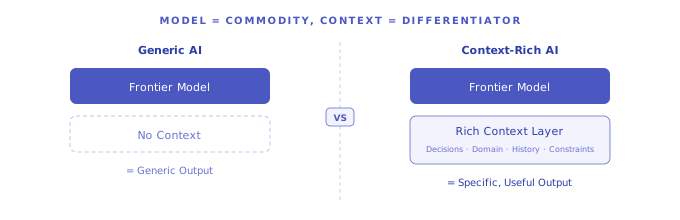
The primary vector of AI development has shifted from raw model benchmarks to the operational context supporting agent execution.
I observe this dynamic across two environments: during the day, designing enterprise platforms for field service and logistics; in the evenings, building side projects with Claude Code and an Obsidian vault holding accumulated product knowledge. Both point toward the same reality.
Industry attention remains focused on foundation model benchmarks and evaluation leaderboards. However, the gap between theoretical capability and effective domain execution stems from missing organizational and architectural context.
What Linear just said out loud
Linear recently published an essay titled “Issue tracking is dead,” highlighting how software coordination is evolving.
Historically, issue tracking managed handoffs between product managers and engineers through status updates, ticket prioritization, and administrative ceremony.
Linear positions its platform as a shared system turning product context into execution, aggregating user feedback, strategic intent, architecture decisions, and code for both human teams and autonomous agents.
The adoption numbers reflect this transition: coding agents are installed in over 75% of Linear’s enterprise workspaces, authoring nearly 25% of new issues, while agent-completed tasks expanded 5x in a single quarter.
Agent productivity depends directly on shared context. As Linear noted: “Agents are not mind readers. They become useful through context.” Customer feedback, roadmap rationale, and architectural constraints must live in accessible repositories.
That represents a product investment in context infrastructure rather than model development.
The pattern in vertical AI agents
The same pattern governs vertical AI applications across logistics, healthcare, and finance.
In vertical logistics agents, foundation models provide the baseline runtime, while integration into transport management systems, carrier portals, and operational email threads creates the core value. The agent succeeds by interpreting industry-specific exception flows and booking rules.
Without operational context, an agent remains a conversational interface unable to process transactional workflows. Foundational models provide the runtime, while proprietary context delivers the actual value.
Five layers deep
The Product Masterclass published a structured framework for context engineering across product teams, identifying five distinct layers:

Strategy context. Long-term direction, positioning, business constraints, and strategic bets.
Discovery context. Customer interview findings, validated user problems, and jobs to be done.
Roadmap context. Planned initiatives, deprioritized scope, and explicit trade-off rationale.
Technical context. System architecture, data schemas, API specifications, and repository backlogs.
Design context. Interface flows, component libraries, and design system tokens.
Agent inconsistency usually stems from session amnesia rather than prompt phrasing. Reliable execution requires persistent context architecture.
Building a second brain that agents can read
I apply this model directly to my own projects using a structured knowledge vault.
An Obsidian vault organized by the PARA framework stores product decisions, design tokens, copy guidelines, data schemas, and architectural context.
When executing tasks with Claude Code, specialized agents pull directly from this knowledge repository. A UX Writer agent validates interface copy against documented voice standards, a Security Engineer reviews database policies against architectural threat models, and a Product Manager agent verifies scope against roadmap rationale.
Configuration files define repository conventions, while structured memory files log technical edge cases and testing rules.
This architecture provides agents with continuous access to documented decisions, domain constraints, and design patterns.
The distinction between generic output and precise implementation reflects the depth of available context.
The objective is establishing an AI workflow grounded in historical decisions, design constraints, and technical standards.
What this means for software products
As context becomes the primary differentiator, competitive dynamics in software shift.
Standard issue tracking interfaces are straightforward to build. However, a platform that aggregates team decisions, customer feedback, and codebase intelligence into an agent-accessible repository creates compounding utility.
Linear’s strategy focuses on context density. As product knowledge accumulates within the system, agent accuracy improves and operational efficiency compounds.
The same logic applies across vertical software: defensibility stems from deep integrations, domain rules, and accumulated operational context rather than the underlying model.
Structured personal documentation creates a similar compounding advantage for individual practitioners, providing the necessary context to make AI collaboration accurate and reproducible.
The shift
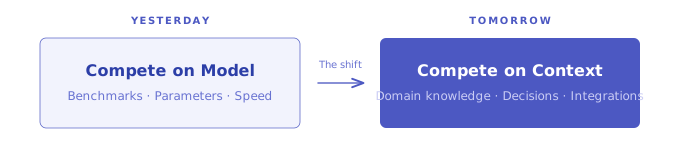
The industry conversation is shifting from model selection to context architecture.
Foundational models will continue to advance in speed and reasoning. However, differentiation lies in whether an agent possesses sufficient context to write code matching a specific architecture and draft communications referencing verified decisions.
Context engineering represents a core strategic position. Teams that build and maintain structured context systems unlock compounding returns from AI workflows.
The model provides the execution engine; persistent context provides the operating intelligence.
This is Part 1 of the Context Engineering series. Continue with Part 2: Where Should Your Context Live? and Part 3: Not All Context Changes at the Same Speed.
References: Linear (“Issue tracking is dead”), Product Masterclass (Context Engineering for Product Teams), Anthropic (Effective Context Engineering for AI Agents), Manus (Lessons from Building Manus).