Product Strategy/ ·4 min read
When the Product Can't Sell Itself
PLG /Product Strategy /Enterprise Software
Industry growth commentary frequently highlights product-led growth success stories: Linear reaching enterprise scale with minimal marketing spend, Figma driving bottom-up adoption, or assertions that superior interfaces eliminate the need for enterprise sales teams.
Enterprise operational software operates under fundamentally different market conditions.
In field service management and route optimization, deployments require months of ERP integration, vehicle telematics configuration, and multi-department procurement reviews. Purchasing authority sits with executive operations or IT leadership, while daily users are dispatchers and field technicians. An unassisted self-service trial provides limited value when meaningful evaluation requires deep historical operational data.
Conversations often polarize between dismissing self-service entirely due to heavy ERP dependencies, or advocating for unassisted trials without considering how an unconfigured route optimizer appears to evaluators.
Building Morningbrew as a side project provides a contrasting baseline. In a consumer specialty coffee application, self-service adoption operates as expected: users log in, record a coffee, explore the roaster map, and evaluate utility in minutes without organizational friction.
Examining that contrast highlights what the product-led model offers to enterprise platforms where unassisted purchasing is impossible.
The model, as advertised
The standard product-led loop relies on rapid time-to-value, organic internal sharing, and individual user purchasing authority.
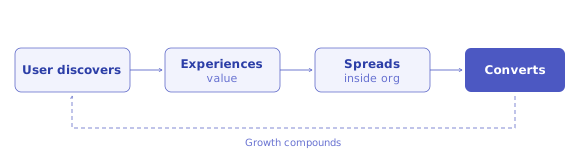
This loop succeeds when three conditions hold: rapid time-to-value, user influence over budget, and organic workflow expansion.
For Morningbrew, all three conditions are present: the end user and the decision-maker are the same individual.
For enterprise route optimization, those conditions invert. The software requires operational datasets, vehicle parameters, and contract constraints to demonstrate value. Daily dispatchers do not control six-figure enterprise budgets, and utility software rarely spreads virally.
The buyer evaluates financial risk. The user evaluates daily workflow friction. Bridging that gap is the core product challenge.
An OpenView survey indicates that only 25 percent of SaaS companies with over 1,000 employees consider unassisted PLG a primary growth vector. The majority of enterprise software providers recognize that the pure self-service model does not match enterprise procurement realities.
What enterprise case studies reveal
Examining successful product-led enterprise companies reveals a hybrid structure combining interface-led discovery with direct sales execution.
Linear scaled through product quality and engineering advocacy, but added dedicated sales-assisted workflows to navigate enterprise security, procurement, and compliance requirements.
Figma documented that 70 percent of enterprise agreements originated with users on free tiers. However, the company paired bottom-up adoption with a specialized enterprise sales organization trained in product workflows to navigate procurement committees.
Datadog illustrates this balance: while comprehensive monitoring infrastructure requires technical deployment, the platform is engineered to deliver initial telemetry within one hour. Datadog uses self-service trials to generate user conviction, while a large enterprise sales team negotiates agreements accounting for 86 percent of recurring revenue.
McKinsey research across 625 enterprise SaaS buyers indicates that 65 percent prefer combined product-led and sales-assisted evaluation during purchasing decisions.
The strategic question centers on how much evaluation work the interface can complete before direct sales engagement.
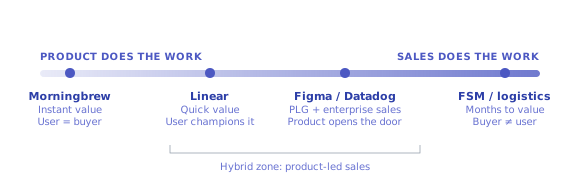
Hybrid evaluation in enterprise workflows
While route optimization engines require operational data to deliver production schedules, the interface can establish credibility before formal sales calls.
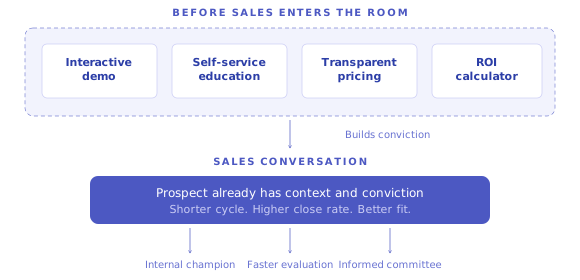
Effective hybrid mechanisms include:
- Interactive walkthroughs with pre-loaded operational data: Allowing prospective dispatchers to evaluate constraint-solving and map interfaces without technical integration.
- Self-service ROI calculators based on empirical benchmarks: Enabling operations teams to model fleet cost reductions using verified industry data.
- Transparent pricing frameworks: Giving evaluators immediate visibility into budget compatibility.
These mechanisms change the nature of initial sales conversations: prospective customers arrive with verified product understanding, allowing sales teams to focus on technical integration and procurement requirements.
Self-service interfaces in consumer applications deliver instant utility. In enterprise software, interface-led evaluation builds operational conviction before contract negotiations begin.
Strategic takeaways
Pure unassisted self-service rarely fits enterprise operational software, where implementation requires deep ERP integrations and buying authority sits far from daily dispatchers.
However, relying entirely on unassisted sales demos leaves valuable leverage on the table.
Datadog demonstrates that engineering rapid initial time-to-value builds stakeholder conviction early, accelerating subsequent sales cycles.
Product evaluation and sales engagement function as complementary mechanisms within enterprise procurement.
Interactive product walkthroughs with pre-loaded operational datasets offer an immediate entry point for enterprise workflows.
Equipping daily practitioners with structured data creates bottom-up advocacy. When dispatchers and route planners can generate verified projections on saved driving hours and fuel costs, they can present a concrete business case to executive buyers.
The product equips practitioners with concrete ROI data to present to internal budget holders, bridging the gap between daily users and executive buyers.
References: McKinsey (Product-Led Sales, 2023), Bain (PLG Development, 2024), Elena Verna (Amplitude Growth Studies), OpenView SaaS Benchmarks, Figma S-1 Filing, Datadog Financial Reports.